
Recently on this blog, danah boyd set off a firestorm by suggesting that the imposition of real names on social media sites is an abuse of power…or even authoritarian. The obvious retort is “don’t like it, don’t use it”, or learn how to segement one’s network (i.e. bend to the system, because its your problem). But I’m here to take another angle on this one: real name sites are necessarily inadequate for online audiences. Yes, necessarily inadequate. I once had a dream that people could seamlessly manage their social networks on any site through some combination of visulaization and clever user interfaces. It was based on the visualization of Facebook networks. People who see these networks, as I’ve discovered in many interviews (early work discussed here), readily identify the myriad social contexts in their networks. One cluster is clearly family, another is clearly coworkers, and so forth. As such, it seemed like the next step would be to use this information to create some sort of selective sharing interface. These are Google+’s social circles (or Diaspora’s Aspects), except determined semi-automatically. Then one could simply select which context, and read from it, or post to it.
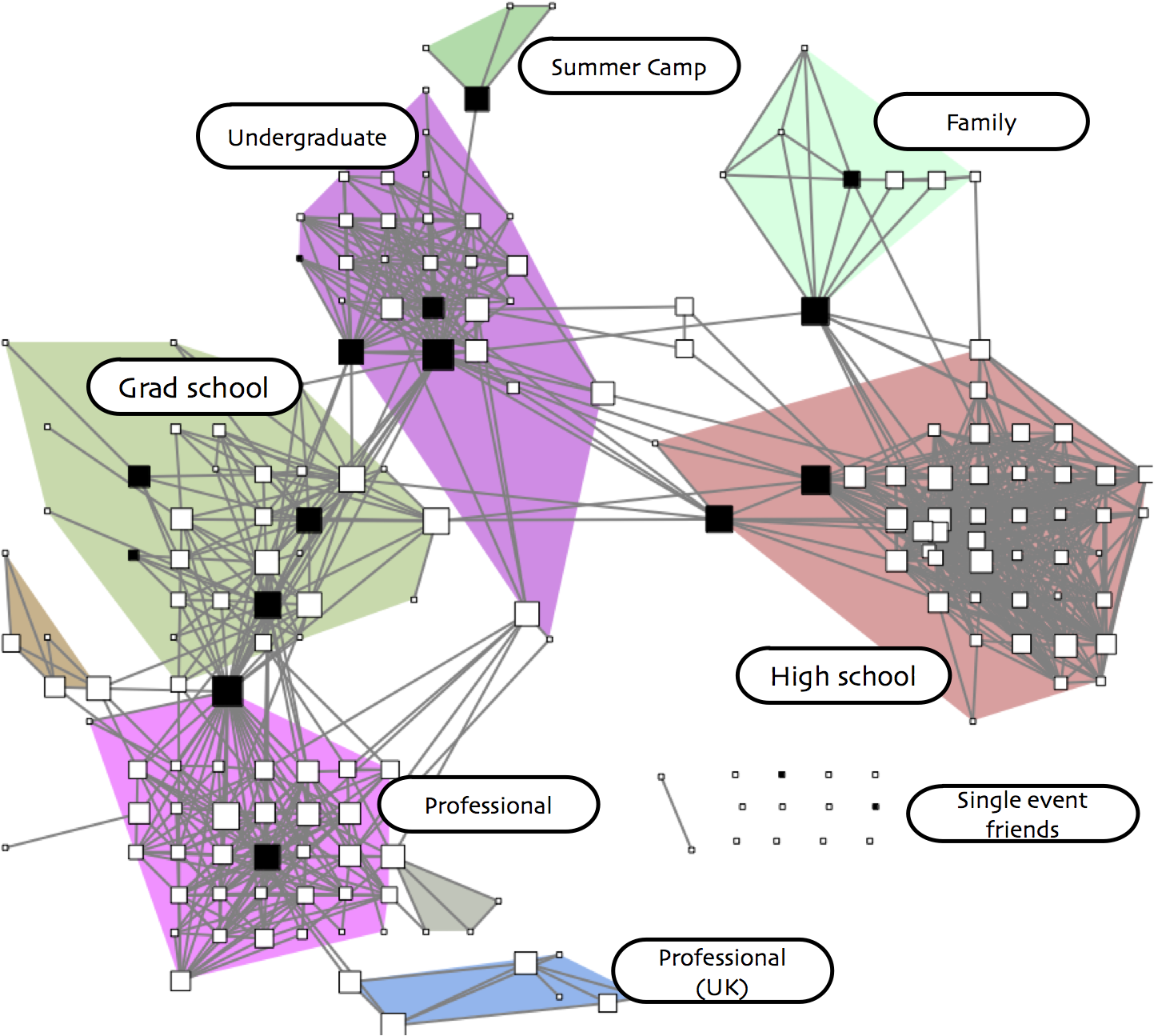
This is “the myth of selective sharing” (as Marc Smith calls it). Its an engineer’s dream based on a misunderstanding of the key distinction between offline and online life. Offline we assume that our conversations are not encoded and thereafter not available to people outside of our immediate audience, by default. Yes, some lucky people give talks to large audiences, they get on the radio or tv. Most don’t. But everyone has some reason to share things with one person but not another. We don’t need to go as far as whistle blowers, political dissidents or closet cases in religious areas. Lots of people have grievances with their bosses, or find someone else attractive, or have problem students / subordinates they need advice on. Lots of people need advice on their own issues, be it alcoholism, drug abuse or gambling. When people do this offline, they do it in situations: temporally and spatially bounded contexts for action. The pub after work; the patio over a cup of coffee; the closed door meeting. But what do we mean by offline anymore? Some assume it is when they are not searching and browsing the web? Or when they aren’t streaming video, emailing someone or inside a virtual world. Being offline actually refers to a much more limited space than that. Being online is being encoded and having that which is encoded available to some party other than those immediately present. You are not online when you are in front of a computer – you are online when your actions are being digitized and networked. Online is on-the-record. Offline is off-the-record.
Offline people say things appropriate to the group they are in. That doesn’t mean they are two-faced, insincere or liars. It means people are context aware. People observe walls, clocks, furniture, fashion and music. These things guide us as to the appropriate way of acting. The guy writing his novel at the bar on Friday night is out-of-place. The guy who shows up to work drunk on Monday morning has a problem. Offline people don’t have to worry about their real name, because their behavior is tied to the context and the impressions the foster in that context. In fact, I’ll say that even more strongly – if your speech is not confined to the context you are in – but available to a potentially unknowable audience – you are online.
This is why real name sites are necessarily inadequate. They deny individuals the right to be context-specific. They turn the performance of impression management into the process of curation. Facebook curates through the top news feed, Twitter does it through lists and Google+ through some confusing (and as far as I can tell, failing) social circles model. Impression management means selectively presenting an idealized version of one’s self specific to that context. Curation means selecting objects for display. So if you don’t think that being context-specific is a right, consider what you think the ‘free’ means in the right to free speech. When my speech is necessarily encumbered by a tethering to a single all-encompassing key (the real name) that unlocks whatever I say, I am no longer free to address one specific context and not another one. I am engaging in a trust relationship with the curator, but I am not free to say what I want. Sometimes that relationship fails [see: weinergate or whatever is the scandal du jour], sometimes its out of my control (when others post on my behalf, tag me, etc…)
Of course, this applies most strongly to non-addressed spaces. When I address someone in an email or on the phone, I am still online, but I’m not necessarily subject to curation. I send a message to a specific recipient, I expect that recipient to get the message, not have gmail decide (but even then spam is filtered out through some curation). On the other hand, when I submit content to social media sites, I do not have a clear view of who is, or will see it, outside of some vague notion of friend lists.
Pseudonyms have long been a way out of this situation. Someone might have one name for an anonymous support group, another for a group of bi-curious and closeted individuals (or just for sex in general), another for a message board about programming, and one for politics or political action. If these were mine, then the choice to blend them or keep them separate is mine. Real names and third-party curation takes away that choice. In their place they offer many advantages, but freedom is not one of them. And that’s why the imposition of one name, one network for all is an abuse of power. It says not only is the curator better at deciding who you should read your content than you, the curator won’t even give you the choice to begin with. (Cross posted at my blog)
 Social Media Collective
This is so sharp: “if your speech is not confined to the context you are in – but available to a potentially unknowable audience – you are online.”
Sadly, this danger is extending into physical space as well due to increasingly pervasive use of video surveillance in public. There’s a huge difference between being seen in public by people who are there, and having your movements and speech recorded possibly forever. I don’t want to be “online” when walking down the street, but in my city we’re heading in that direction.
These arguments make some valid points but miss the big point.
You make a correct distinction between offline spaces, where speech is confined to context (unless bugged, etc). and online spaces where speech is, as a rule, permanent and public. You point out correctly that the offline space allows more freedom to act.
You then claim that outbound access restrictions (G+ circles, LJ friend lists) offer inadequate protection of your speech, while personal email or pseudonyms offer good protection. In general I disagree. In all these cases you are trusting the recipient. Circles and friend lists are not vague, they’re exactly like email To: lists. Be careful who you trust with your message. If people carelessly re-share your posts intended from a limited circle, they may also resend your emails, or publicly out your real name in relation to your alias (this kept happening on LJ), or just be poor at account security and have their accounts hacked. There are differences of degree, but no more than that.
Then your main thesis is that free speech online, and therefore pseudonyms, is a right. I agree. But you then jump to the conclusion that all online spaces need pseudonyms. This misses the point of G+ and Facebook, entirely. Their point is to create a space to interact on the basis of real names. I hate to say this, but they are intended for people who like the real names policy. If you join and complain you are, in the first place, inconsiderate. There are tons of other online spaces where pseudonyms are the norm. Yes, they are more fragmented and thus grant a smaller audience. That’s part of the deal.
Your argument will be valid if G+ becomes THE network, so it has to be seen as a public service and therefore allow pseudonyms and other concessions to universality. This will probably happen, but I think the “we need pseudonyms” argument is premature and damaging to the “real names” space that G+ is trying to create.
At the moment G+ is just shiny. A bunch of people have camped on a small shiny patch of grass and they put up a sign “All welcome, but speak English”. Then lots of other people who stood on less shiny patches run along and say “OMG how discriminatory we demand to come here and speak German, etc.”
On the one hand, no-one should enforce the “speak English” rule because there’s no civil way to do so. On the other, the people who refuse to speak English are being asses.
Thanks for the feedback Pavlos. But I don’t think I’ve missed the big issue. I’m making a distinction between addressed and non-addressed media. In addressed media we are trusting our recipient. In non-addressed media we are trusting our curator, not our recipient. That’s a sea change of difference as we’re placing trust not in the hands of our known and targeted audience, but in the designers of these spaces and their algorithms. As far as I know, its permissable to criticize the rise of the real name web (or at least try to suggest that such policies don’t leak out into “real ID” and other ‘solutions’ to non-problems), and I think that policies are subject to debate.
Pavlos, interesting comment but I also don’t think Bernie missed the point regarding G+ (quite suddenly) becoming a Real Name service. Facebook and LinkedIn are defacto real name services because that’s how they started (Facebook by convention and LinkedIn by its mission statement). These two were entirely new services when they started, unconnected to any other service. G+, on the other hand, is part of the larger Google product offering and, for those of us who already have a Gmail account, buzz account, picasa account, reader account — which are all intertwined with our google login name (my GMAIL email account name), that means that we Google users already have established identities via buzz, gmail, picasa, and reader. And *that* means that if we have already established a pseudonymous representation of ourselves on Google’s productline, Google is either forcing us to out ourselves or telling us to F*off and go away.
Sorry Google. The horses left the barn long long long ago. The majority of the people I know on Google’s products are pseudonymous *unless* they have a professional account via Google Apps.
Many people with Google accounts don’t need another Facebook or LinkedIn. We already have those and updating another is more work than we need. What we do want is a place to allow our established Google account personas to continue flourishing in new ways. For some people, this means their professional persona (which may or may not be branded with their wallet name). For others, it means other personas that do not necessary need to be associated with our wallet names (or our bank accounts, birthdates, home addresses and any other info that is vulnerable to hacking).
Excellent, excellent post. Context and identity are everything.
A while ago I was posting regularly at a gawker site, but never really signed up for it. I had a specific username, got some likes and comments back. I decided to finally just register (so I wouldn’t have to deal with the constant e-mail entry). I had to pick a separate name, and began posting. I was almost immediately deleted as a “troll”. The reason I’m telling this story is, I wonder, if I’d simply used the other name – my established pseudonym – would that have happened?
It is all about context. It’s about building up relationships.
Google is, essentially, requesting we break numerous relationships – both online (by disallowing ‘handles’) and offline (by linking all its products to Google Plus’s profile – a real name – allowing, for example, my boss to see that comment I posted five years ago under a Google ID nickname that is now suddenly associated with my real name).
Again – great article. I hope Google fixes this, but as the weeks go on it’s looking less and less likely.
Pingback: Who Am I? | engineawry
Ok, I’m trying to follow your logic and I think I’m failing because your logic is faulty.
You make a big deal about “addressable spaces” vs. non-addressable spaces and then you assume that social networks are non-addressable spaces. You even dismiss the possibility that they are addressable by saying “vague notion of friend lists”.
That is the fault in your logic, friend lists are a distinct set of address’ in the users control, so dismissing them is a mistake.
The reason for this mistake is obvious, we’ve been trained to think that.
Twitter claims to have “lists” but they really are for consumption of content, not targeting of content.
Facebook has the capability to target content but it is not the default, the default is a true non-addressable space, the Extended Network.
If one is speaking to multiple contexts at once, and not to a person or trusted set of people in particular particular, it is not addressed to individuals, it is broadcast to a group. We have cognitive limits as well as social limits on how many people we can manage. Get outside of that limit and you are basically speaking from a role rather than to a person.
What I like about Sean’s response is that we have been trained to think (I think the word conditioned is better). In that respect we would like to think we are far removed from a computer but we try to feed into a computer what is happening, in the hope to figure out why it’s happening. And we keep failing when the what is partial and not whole.
Sean is addressing what Facebook is, a computer program. He isn’t addressing how you follow the people who use the program. Douglas Rushkoff addresses that when he talks about “program or being programmed”, but Sean does address the most human part of our quality – the way we think.
I am never going to be a logic meister but I can utilize social media to learn to see why I am thinking what I am thinking. In the offline world gossip is the network food of choice not logic, in the online world logic has a greater underpinning and yet we don’t focus on our condition, but “nymwars”?
That is why I think Rushkoff says that we have to learn to program. In the Eastern world, the connectedness of extended networks equals culture, in the Western world this connection was abandoned until the rise of social media, has in effect begun to connect it again. That is what Marshall McLuhan also saw.
Ultimately, when I hear people say “stop blaming social media”, they should be saying “stop blaming my use of social media” – but machine and human is so closer in design today, I think we fail to see that extra dimension of conditioning. I need to understand what people like Sean are saying because I don’t understand the logic of the machine. I need to understand logic because the use of logic sits behind how we are programmed.
I don’t want the end point of logic to turn the word “human being” into another chapter in a computer science book – I want the end point of logic to be an improvement in understanding and most of all thought. I am not a perfect program and I never will be, but I don’t mind if someone builds a perfect machine, because in the end, we will still always be able to gossip about it.
[Em]
Reading posting, Google circles are only good for directing your broadcasts to limited private groups.
Google circles *fail* to solve the problem of setting context during public posts. If I want to make public posts about politics, Google wants me to not only do it under my real name but also *spam my entire* subscriber list with political posts that may be uninteresting (or even offensive) to them. Furthermore, my job strongly pressures me to not have public political opinions and it would be inappropriate to mix these two context steams.
Bernie’s argument about contexts is right on the money.
Should be: “Regarding posting” (not reading posting)
I’m with you in spirit, Bernie, but I’m not sure the argument you construct here bites very effectively.
You say, “if your speech is … available to a potentially unknowable audience – you are online”. As far as I can tell, G+ circles are made up only of knowable audience. If you don’t add someone to a circle, it appears they will not receive updates sent exclusively to that circle. If there is a free-speech-related flaw here (and I’m not saying there isn’t), it must apply equally to email?
On the issue of using real names, I can’t see from your argument that real names are necessarily inadequate for free speech. If Google were to develop their profile system so that you could present alternative profiles to (a) people you don’t know, (b) people who are in your Work circle, and (c) your Close Friends circle, then wouldn’t you be as “in control” of the context of your messages as you are in “offline situations” like your local bar, or a job interview? Or, if you stored no profile information at all, and let only your messages in different circles speak for themselves, aren’t you adequately in control of the context?
It seems clear to me that pseudonyms enhance free speech and personal safety in countless situations, but I’d be interested to hear you argue in more detail on why real names are fundamentally inadequate.
Circles are one-way. They offer privacy to the sender, not the person who replies. I keep seeing people say “I know, let’s have a different persona for each circle”, but that doesn’t work. How does the person *replying* identify which persona to reply to? They don’t even know which circle (if any, or if one) the message was sent to.
You know how you read about those huge fails when someone does a Reply-All instead of a Reply? That’s Circles. You have no idea if you’re replying to “Bob’s friends who were at the stag party” or “Bob’s circle of everyone at the office”. You can see a random list of people who the message went to, but that may not be enough. I can’t wait to hear about the first person who gets fired because they assumed one and got the other.
I agree – I love the concept of circles and they can protect you on Google +, however the name you use for Google Plus is visible to everyone AND is applied to your Google ID (which I’ve used over the past few years to reply pseudonymously to comment threats).
Google Plus touts being able to separate your life into circles, but insists on having every google service irrevocably and uniformly linked. Oh, the irony.
Sure, they’re inadequate, but they are by far, the MOST POPULAR!
People like real name networks.
They are stupid and bland. But it’s what people like.
Instead of complaining about how horrible Facebook and G+ are, people should be working on new ones. I’d like to see someone make a non-real name network that gets my family to join it. Don’t think it’ll happen but you should still try.
It’s the most privileged who are most accustomed with using aliases online. It’s the digital newbies (read: the poor, the elderly) who are the most comfortable with real name social networks.
A Fake Name Fan:
“It’s the most privileged who are most accustomed with using aliases online. It’s the digital newbies (read: the poor, the elderly) who are the most comfortable with real name social networks.”
I saw almost this exact statement on another site – as a “poor” person, I’m sorry I didn’t get the memo that I’m supposed to hate aliases. I think you’ve got it backwards – the privileged are more accustomed to using real names. It’s those who are powerful/rich enough to survive an internet backlash into real life that have no need for an alias. Those of us who are in incredibly debt and need to keep their jobs and cannot have them put in jeopardy because we say something our bosses don’t like (I wrote a fiction story a while ago online, a character used the “f” word once in it, in my off-time, using me real name….and got hauled into my boss’s office and threatened with a firing unless I took it down).
The poor shouldn’t be afraid of aliases – it doesn’t make sense. What make sense is the super-wary/gullible are afraid of aliases – those who are unwilling to trust the words of someone without an “acceptable” name and then completely willing to trust anyone with an “acceptable ” name.
These are the people who make fun of “ethnic” names. These are the people who refuse to call a woman by anything other than her husband’s name (even though she’s not changed it). Why are we catering to the stupid/intolerant?
I was interested when I read the headline, but then you meander into a whole set of distracting arguments that don’t really illuminate the topic or support your point.
Claims like this are naive and short-sighted:
“Being online is being encoded and having that which is encoded available to some party other than those immediately present. You are not online when you are in front of a computer – you are online when your actions are being digitized and networked. Online is on-the-record. Offline is off-the-record.”
The dichotomy of “being online” and “being offline” is a convenient fiction to support your argument. Your statements appear to assume the internet is a mature space with defined characteristics that we must accept; that it will not evolve to have levels of privacy that are trusted and enforced far better than they are today. (It will.) You declare that “you can be digitized and networked” as an ostensible truth when it is a vague and ill-defined concept.
Am I being digitized and networked when I am standing at the ATM machine being videoed as I withdraw cash? When I am online using Email? Commenting on this blog? Posting to a mailing list? Rating songs on iTunes? Having my browser accept cookies without my knowledge? When I am being wiretapped by the feds?
Today, it’s a mess, and tomorrow it will be less. But there is no need or innate desire by people to accept or embrace the idea that you can be in a space where the unknowing masses are privy to what you say. It is the limitation of today’s internet that causes people to be willing to accept this. But really, it is a bug. It will get fixed.
It is a mess, and yes you are being digitized and networked at the ATM macine. The question is who curates and unifies that data. These things are all on the record, and it is good that they are a mess insofar as that means there are still spaces where our data is not a unified totality under someone or something’s control.
Pingback: Google’s Double-Plus Real Names « Signifying Media
Pingback: “If you don’t like it, don’t use it. It’s that simple.” ORLY? « Social Media Collective
Pingback: Google+ comment on Danah Boyd+ post re: nymwars « mind chatter
Pingback: Anonymity in the geoweb | ryan burns – university of washington
Pingback: Identity, non-addressed audiences and the myth of selective sharing… | Incite Stories
Pingback: User privacy, market research, and social listening | GutCheck
Pingback: MP 113 Google Plus, Real Names vs Pseudonyms, iPad Scam and Building a Brand for Yourself | Micro Patrol
Some interesting points. Now that Facebook are openly moving towards being a platform rather than merely a site, we could see the kind of private vs. public service problem described by Peter Jenkins in “The Virtual World as Company Town” (Journal of Internet Law 8/1). There he considers whether users of virtual worlds have free speech rights, but similar considerations apply to other platforms, such as social networks, and to other rights, including privacy and anonymity.
opqxkuwmaygm
Thanks for ones marvelous posting! I genuinely enjoyed reading it,
you might be a great author.I will ensure that I bookmark your blog
and definitely will come back later in life. I want to encourage you to ultimately continue your great writing, have a nice holiday weekend!
My partner and I absolutely love your blog and find the majority of your post’s to be precisely what I’m looking for.
Do you offer guest writers to write content
to suit your needs? I wouldn’t mind writing a post or elaborating on a number of the subjects you write regarding here. Again, awesome blog!
My partner and I stumbled over here coming from a different web page and thought I might as well check things out. I like what I see so i am just following you. Look forward to going over your web page repeatedly.
I like what you guys are usually up too. This kind of clever work and exposure! Keep up the fantastic works guys I’ve incorporated you guys
to my blogroll.
Hello there I am so grateful I found your weblog, I really found you by error, while I was researching on Digg for something
else, Nonetheless I am here now and would just like to say kudos for a incredible post and
a all round entertaining blog (I also love the theme/design), I
don’t have time to go through it all at the minute but I have bookmarked it and also
added your RSS feeds, so when I have time I will be
back to read much more, Please do keep up the superb job.
Admiring the persistence you put into your site
and in depth information you offer. It’s good to come across a blog every once in a while that isn’t the same outdated rehashed
information. Wonderful read! I’ve saved your site and I’m adding your RSS feeds to
my Google account.
Greetings! I’ve been reading your blog for some time now and finally got the courage to go ahead and give you a shout out from Humble Texas! Just wanted to say keep up the fantastic work!
I’m really loving the theme/design of your weblog. Do you ever run into
any internet browser compatibility issues? A handful of my
blog visitors have complained about my website not operating correctly
in Explorer but looks great in Safari. Do you have any
advice to help fix this issue?
I’m curious to find out what blog platform you have been using? I’m experiencing some minor security problems with my latest website and I would like to find something
more safeguarded. Do you have any suggestions?
Hmm it looks like your site ate my first comment (it was extremely long) so I
guess I’ll just sum it up what I submitted and say, I’m thoroughly enjoying your blog.
I too am an aspiring blog writer but I’m still new to the whole thing. Do you have any suggestions for inexperienced blog writers? I’d
definitely appreciate it.
Woah! I’m really enjoying the template/theme of this website. It’s
simple, yet effective. A lot of times it’s hard to get that “perfect balance” between usability and visual appearance. I must say you have done a excellent job with this. Additionally, the blog loads extremely fast for me on Internet explorer. Exceptional Blog!
Do you mind if I quote a few of your articles as long as I provide credit and sources back to your weblog? My blog site is in the very same area of interest as yours and my visitors would genuinely benefit from some of the information you provide here. Please let me know if this alright with you. Appreciate it!
Howdy would you mind letting me know which webhost you’re using?
I’ve loaded your blog in 3 completely different internet browsers and I must say this blog loads a lot quicker then most. Can you recommend a good hosting provider at a fair price? Thanks a lot, I appreciate it!
Wonderful site you have here but I was curious if you knew of any forums that cover the same topics discussed here? I’d
really love to be a part of group where I can get responses
from other knowledgeable people that share the same interest.
If you have any recommendations, please let me know.
Thanks a lot!
Hi there! This is my 1st comment here so I just
wanted to give a quick shout out and say I genuinely enjoy reading your posts.
Can you recommend any other blogs/websites/forums that deal with the same subjects?
Thank you so much!
Do you have a spam issue on this website; I also am a blogger, and I was wondering your situation; we
have developed some nice procedures and we are looking to swap strategies with others, please shoot
me an email if interested.
Please let me know if you’re looking for a article writer for your blog. You have some really great articles and I think I would be a good asset. If you ever want to take some of the load off, I’d love to write some
content for your blog in exchange for a link back to mine.
Please blast me an email if interested. Kudos!
Have you ever thought about adding a little bit more than just your articles?
I mean, what you say is fundamental and everything. However imagine if you added some great visuals or video clips to give your posts more, “pop”!
Your content is excellent but with images and videos,
this blog could undeniably be one of the best in its field.
Great blog!
Interesting blog! Is your theme custom made or did you download it
from somewhere? A design like yours with a few simple tweeks would really
make my blog stand out. Please let me know where you got your theme.
Bless you
Hey would you mind stating which blog platform you’re working with? I’m planning to start
my own blog in the near future but I’m having a difficult time selecting between BlogEngine/Wordpress/B2evolution and Drupal. The reason I ask is because your layout seems different then most blogs and I’m looking for something completely
unique. P.S Apologies for getting off-topic but I had to ask!
Hello just wanted to give you a quick heads up.
The text in your post seem to be running off the screen in Ie.
I’m not sure if this is a formatting issue or something to do with web browser compatibility but I thought I’d post to let you know.
The layout look great though! Hope you get the issue resolved soon.
Many thanks
With havin so much content and articles do you ever run into any problems of plagorism or copyright violation?
My site has a lot of unique content I’ve either written myself or outsourced but it appears a lot of it is popping it up all over the web without my agreement. Do you know any methods to help stop content from being ripped off? I’d certainly appreciate it.
Have you ever thought about publishing an e-book or
guest authoring on other blogs? I have a blog based on
the same ideas you discuss and would love to have you share some stories/information.
I know my subscribers would value your work. If you’re even remotely interested, feel free to shoot me an e-mail.
Hi there! Someone in my Myspace group shared this website with us so I came to look it over. I’m definitely enjoying the information.
I’m bookmarking and will be tweeting this to my followers! Excellent blog and superb design and style.
Wonderful blog! Do you have any tips and hints for aspiring writers? I’m hoping to
start my own blog soon but I’m a little lost on everything. Would you propose starting with a free platform like WordPress or go for a paid option? There are so many options out there that I’m completely overwhelmed .
. Any tips? Thanks a lot!
My coder is trying to convince me to move to
.net from PHP. I have always disliked the idea because of the costs.
But he’s tryiong none the less. I’ve been using Movable-type
on several websites for about a year and am anxious about switching to another platform.
I have heard great things about blogengine.net. Is there a way I can transfer all my wordpress posts into it?
Any help would be really appreciated!
Does your blog have a contact page? I’m having a tough time locating it but, I’d
like to send you an e-mail. I’ve got some recommendations for your blog you might be interested in hearing. Either way, great website and I look forward to seeing it grow over time.
It’s a shame you don’t have a donate button! I’d definitely donate
to this superb blog! I guess for now i’ll settle for book-marking and adding your RSS feed to my Google account. I look forward to fresh updates and will share this site with my Facebook group. Chat soon!
Greetings from Carolina! I’m bored to death at work so I decided to check out
your site on my iphone during lunch break.
I enjoy the information you provide here and can’t wait to take a look when I get home. I’m
amazed at how quick your blog loaded on my phone
.. I’m not even using WIFI, just 3G .. Anyhow, very good blog!
Howdy! I know this is kinda off topic however , I’d figured I’d ask. Would you be interested in trading links or maybe guest writing a blog post or vice-versa? My site goes over a lot of the same topics as yours and I feel we could greatly benefit from each other. If you are interested feel free to shoot me an email. I look forward to hearing from you! Superb blog by the way!
At this time it seems like Movable Type is the best blogging platform out there right now. (from what I’ve read) Is that what
you’re using on your blog?
Superb post however I was wanting to know if you could write a litte more on this subject? I’d be very grateful if you could elaborate a little bit further.
Thanks!
Hey there! I know this is somewhat off topic but I
was wondering if you knew where I could find a captcha plugin for my comment form?
I’m using the same blog platform as yours and I’m having trouble finding one?
Thanks a lot!
When I originally commented I clicked the “Notify me when new comments are added” checkbox and now each time a comment is added I get three e-mails with the same comment.
Is there any way you can remove me from that service? Thanks!
Hey there! This is my first visit to your blog!
We are a team of volunteers and starting a new initiative in a community in the same niche.
Your blog provided us useful information to work on.
You have done a marvellous job!
Hello there! I know this is kinda off topic but I was wondering
which blog platform are you using for this site?
I’m getting sick and tired of WordPress because I’ve had issues with hackers and I’m looking at alternatives for another platform. I would be awesome if you could point me in the direction of a good platform.
Howdy! This post couldn’t be written any better!
Reading through this post reminds me of my previous room mate!
He always kept talking about this. I will forward this page to him.
Fairly certain he will have a good read. Thanks for sharing!
Write more, thats all I have to say. Literally, it seems as though you relied
on the video to make your point. You obviously
know what youre talking about, why throw away your intelligence
on just posting videos to your blog when you could be giving
us something enlightening to read?
Today, I went to the beachfront with my kids.
I found a sea shell and gave it to my 4 year old daughter
and said “You can hear the ocean if you put this to your ear.” She put the
shell to her ear and screamed. There was a hermit crab inside and it pinched her
ear. She never wants to go back! LoL I know this is completely off topic but I
had to tell someone!
Today, while I was at work, my sister stole my iphone
and tested to see if it can survive a 30 foot drop, just so she can be a youtube
sensation. My apple ipad is now destroyed and she has 83 views.
I know this is totally off topic but I had to share it with someone!
I was curious if you ever considered changing the layout of your site?
Its very well written; I love what youve
got to say. But maybe you could a little more
in the way of content so people could connect with it
better. Youve got an awful lot of text for only having one or two pictures.
Maybe you could space it out better?
Hi, i read your blog occasionally and i own a similar one and i
was just curious if you get a lot of spam remarks? If so how do you
protect against it, any plugin or anything you can recommend?
I get so much lately it’s driving me mad so any help is very much appreciated.
This design is steller! You obviously know how to keep a reader entertained. Between your wit and your videos, I was almost moved to start my own blog (well, almost…HaHa!) Wonderful job. I really enjoyed what you had to say, and more than that, how you presented it. Too cool!
I’m really enjoying the design and layout of your blog. It’s a very easy on the eyes which makes it much more enjoyable for me to come here and visit more often. Did you hire out a developer to create your theme? Superb work!
Good day! I could have sworn I’ve been to this site before but
after reading through some of the post I realized
it’s new to me. Nonetheless, I’m definitely delighted I found it and I’ll be book-marking and checking back frequently!
Hi! Would you mind if I share your blog with my zynga group? There’s a lot of folks
that I think would really appreciate your content. Please
let me know. Thank you
Hey, I think your blog might be having browser compatibility issues.
When I look at your blog in Firefox, it looks fine but when opening in Internet Explorer,
it has some overlapping. I just wanted to give you a quick
heads up! Other then that, superb blog!
Wonderful blog! I found it while searching on Yahoo News.
Do you have any suggestions on how to get listed in Yahoo News?
I’ve been trying for a while but I never seem to get there! Cheers
Hey! This is kind of off topic but I need some advice from an established blog. Is it tough to set up your own blog? I’m not very techincal but I can
figure things out pretty fast. I’m thinking about making my own but I’m not
sure where to start. Do you have any points or
suggestions? Thanks
Hey there! Quick question that’s completely off topic. Do you know how to make your site mobile friendly? My web site looks weird when viewing from my iphone. I’m trying to find a theme or plugin that might be
able to resolve this issue. If you have any suggestions, please share.
Many thanks!
I’m not that much of a online reader to be honest but
your sites really nice, keep it up! I’ll go ahead and bookmark your website to come back later. Cheers
I love your blog.. very nice colors & theme. Did you make this website yourself or did you hire someone to do it for you? Plz reply as I’m looking to
create my own blog and would like to find out where u got this from.
kudos
Wow! This blog looks exactly like my old one!
It’s on a completely different topic but it has pretty much the same layout and design. Superb choice of colors!
Howdy just wanted to give you a brief heads up and let you know a few of the images aren’t loading properly.
I’m not sure why but I think its a linking issue. I’ve tried it in
two different web browsers and both show the same outcome.
Hey are using WordPress for your blog platform? I’m new to the blog world but I’m
trying to get started and create my own. Do you need any coding knowledge to
make your own blog? Any help would be really appreciated!
Hi this is kind of of off topic but I was wanting to know if blogs use WYSIWYG
editors or if you have to manually code with HTML. I’m starting a blog soon but have no coding expertise so I wanted to get guidance from someone with experience. Any help would be enormously appreciated!
Hey there! I just wanted to ask if you ever have any issues with hackers? My last blog (wordpress) was hacked and I ended up losing a few months of hard work due to no back up. Do you have any solutions to protect against hackers?
Hey there! Do you use Twitter? I’d like to follow you if
that would be ok. I’m absolutely enjoying your blog and look forward to new posts.
Howdy! Do you know if they make any plugins to safeguard against hackers? I’m kinda paranoid about losing everything I’ve worked hard on. Any tips?
Hey! Do you know if they make any plugins to assist with SEO? I’m trying to get my blog to rank for some targeted keywords but I’m not seeing very good success. If you know of any please share. Cheers!
I know this if off topic but I’m looking into starting my own weblog and was wondering what all is needed to get setup?
I’m assuming having a blog like yours would cost a pretty penny? I’m
not very internet savvy so I’m not 100% sure. Any suggestions or advice would be greatly appreciated. Appreciate it
Hmm is anyone else having problems with the pictures on this blog loading? I’m trying to
determine if its a problem on my end or if it’s the blog. Any feedback would be greatly appreciated.
I’m not sure exactly why but this blog is loading extremely slow
for me. Is anyone else having this problem or is it a issue on my end?
I’ll check back later and see if the problem still exists.
Hello! I’m at work browsing your blog from my new iphone!
Just wanted to say I love reading through your blog and look forward to all your posts!
Keep up the fantastic work!
Wow that was odd. I just wrote an very long comment but after I clicked submit my comment didn’t appear. Grrrr… well I’m not writing all that
over again. Anyways, just wanted to say excellent blog!